
Visual Data Design with Guardrails
Define event schemas directly in the context of real user journeys with a shared framework and real-time guardrails to help teams design cohesive tracking faster.
The Avo tracking plan
Start from a shared foundation
Build on a governed framework instead of scattered spreadsheets.
Collaborate safely
Enforced ownership and guardrails that keep teams aligned on tracking changes.
Single source of truth
Sync across your analytics tools, pipelines, and schema registries.
Design Where Data Actually Happens
See and define tracking directly in your user journeys. Avo turns each flow into a clear blueprint with scenarios anyone can understand. Your tracking stays aligned whether you reuse existing structures or create new ones

A Shared Foundation Everyone Can Build On
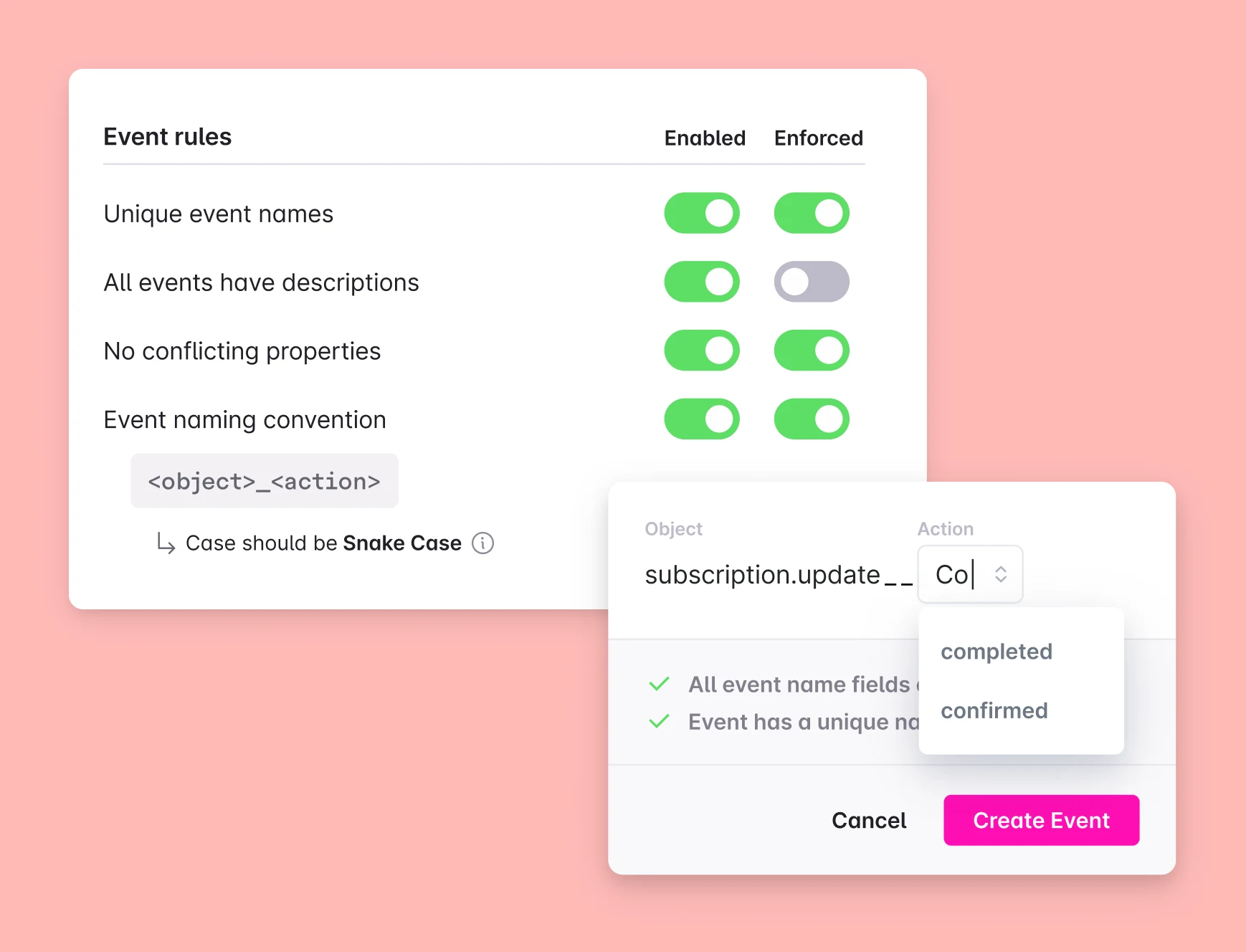
Set clear, enforceable standards for how tracking is designed across teams and products.
Reusable event structures, naming conventions, and allowed values make collaborative data design predictable and scalable.
Delegate without losing control
Enable teams to safely draft tracking changes on a branch and automate pulling in the right reviewers to sign off.
Data design agents and built-in guardrails make it fast and easy for contributors to adhere to standards, reducing back and forth.


Sync across your stack
Sync your tracking plan across your downstream systems and avoid manually maintaining multiple sources of truth.
Update your event structures once and see them reflected in your analytics tools, pipelines, and schema registries.

Before Avo, tracking was one of the most time-consuming parts of my job. Now product managers take ownership of the event structure and I review and approve. It’s much faster—and way less painful.
Elmira Gatina
Projects Coordinator, Analytics Engineering

Common questions
Avo does not collect and route your data to other destinations so, no, Avo is not a CDP. Avo makes sure that the tracking calls you make to your CDP or analytics tool are according to spec so that you can make product decisions based on quality data.
A tracking plan is a central document that everyone in your organisation can refer to for data management best practices. It standardises the events and properties you track, determines where within the code your analytics should be placed, and outlines the reason why each event is being tracked in the first place. I the past, teams have most often managed their tracking plans in Spreadsheets. However, spreadsheets don’t scale and that’s where Avo helps.
Read more in our What is a tracking plan and why do you need one blogpost.
In Avo there is the main tracking plan that acts as a source of truth for your production data structures. You can branch out from the tracking plan, creating a draft state of the main one, to make changes without affecting others. Once the suggested changes have been reviewed, approved and implemented, you merge the branch, updating the main tracking plan to include your changes. Read more about branches in our docs.
If you have an uncommon question, feel free to get in touch with our team.
Contact us